
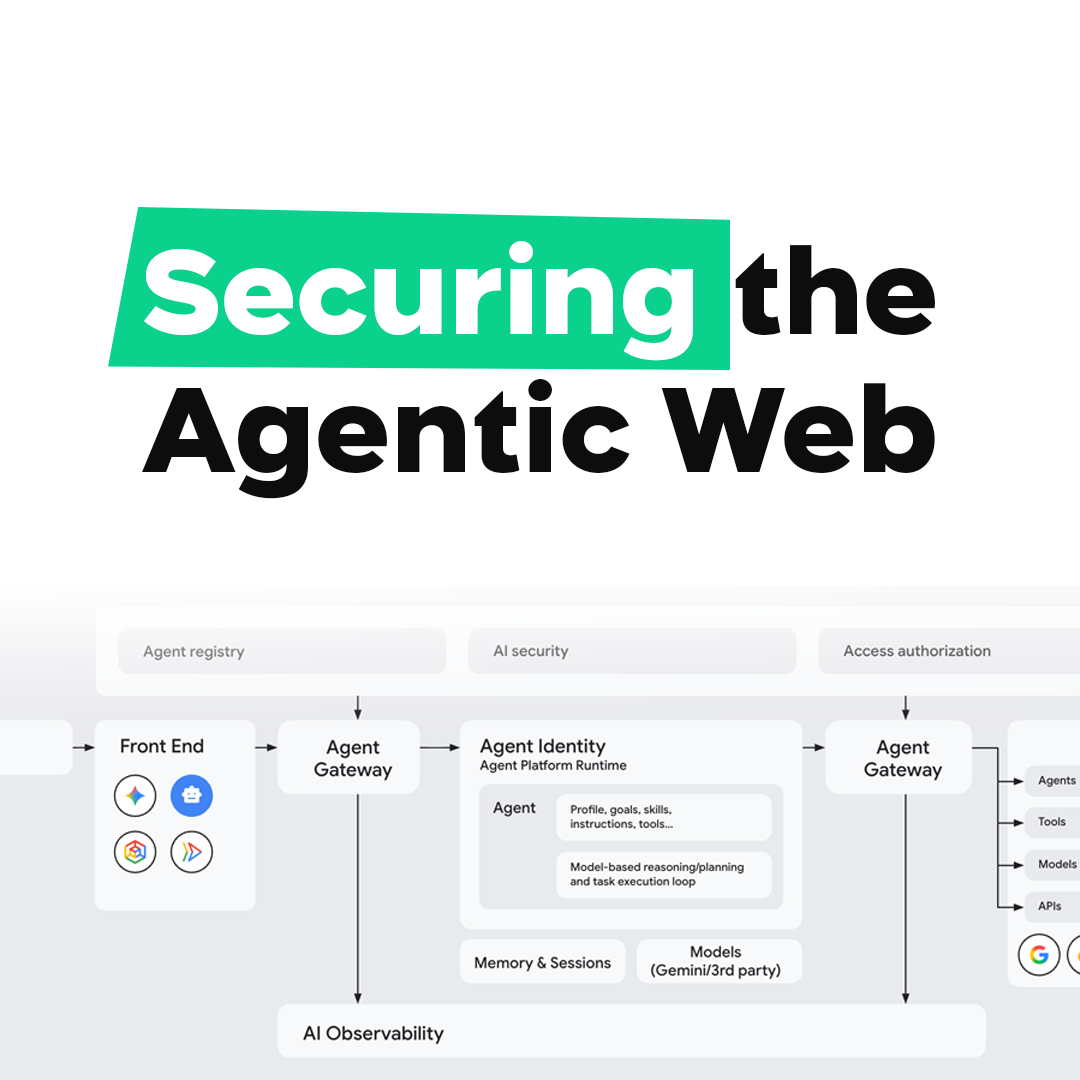
Trust is the new perimeter in the era of autonomous logic. As we move from deterministic software to probabilistic agents, the security landscape has fundamentally shifted. It is no longer enough to secure the user; we must now secure the "intent" of the agent.
At Google Cloud Next 2026, the introduction of the Agent Gateway and Model Armor marked a fresh approach to infrastructure. We are moving towards a world where security is not a "check-box" at the end of a sprint, but a runtime reality that governs every autonomous flow.
The Technical Shift: From Firewalls to Guardrails
In a traditional environment, we secured APIs and endpoints. In an agentic environment, we must secure the "Logic Flow." Agents often have the authority to pull data from Salesforce Data Cloud and push it into a BigQuery environment or a customer-facing Gmail response. This creates a "long-tail" security risk where a single prompt injection could, in theory, bypass traditional authentication layers.
By tapping into Google’s new Runtime Governance models, we are helping our clients build "Guardrails" that sit between the Large Language Model (LLM) and the execution engine. These guardrails do not just stop restricted language; they stop flawed logic. For example, if an agent attempts to pull a "restricted" field from a Salesforce object that is not required for the current task, the Agent Gateway intercepts and redacts the request in real-time. This provides the technical clarity needed to deploy agents in highly regulated industries like finance and healthcare.
Engineering Excellence: A Technical Deep Dive
For the architects and security leads, the following updates represent the new "Gold Standard" for agentic infrastructure:
- Model Armor v2.0: This is a dedicated security layer that sits in front of the Gemini 1.5 and 3.0 endpoints. It uses a "Clean-Pipe" methodology to scrub incoming prompts for adversarial attacks—such as "Jailbreaking"—and outgoing responses for PII (Personally Identifiable Information) leakage. It operates with sub-10ms latency, ensuring security does not drive down performance.
- Wiz & Sentinel Integration: Following Google’s strategic moves in the security sector, Wiz is now natively integrated into the Google Cloud Security Command Center. This allows for a "Single Pane of Glass" view where you can monitor the posture of your Google Cloud agents and your Salesforce Agentforce workers simultaneously.
- Zero-Copy Security Handshakes: One of the most innovative technical updates is the ability to maintain "Data Sovereignty" through Zero-Copy. When a Google Agent accesses Salesforce data, the data is never "stored" or "cached" in the Google environment. It is processed in-memory via a cryptographically signed handshake, ensuring that your "Source of Truth" remains untainted and private.
- Agent Identity (AuthN/AuthZ): Agents now have their own Workload Identities. Much like a service account, but with "Intent-Based Scoping." This means an agent can be granted permission to "Read" a specific dataset only if it can prove the specific business task it is currently executing requires that access.
-
The CloudSmiths Advantage: Forging Trusted Systems
We apply modern methodologies with technical clarity to help you navigate this transition. As a strategic advisor for both Google and Salesforce, we operate as your knowledgeable peers to design the "Security Architecture" that underpins your agentic strategy.
We work with your IT and Security teams to configure the Agent Gateway, ensuring that your Salesforce-to-Google integrations are not just functional, but "Verifiably Secure." We believe that the only way to drive progress is to ensure the foundation is unshakeable. By navigating regional infrastructure and local constraints, we deliver measurable results that align with your technical intent.
Technical Quick-to-Action: 3 Tips for your Dev Stack
- Implement Intent-Based Scoping: Stop using broad service accounts for your agents. Use the new Workload Identity Federation to ensure agents only have permissions that match their specific "Task Scope."
- Enable Model Armor Logging: Do not just block attacks; learn from them. Enable Model Armor’s "Diagnostic Logging" to see which prompt patterns are being used to try and "trick" your agents.
- Audit your Handshakes: If you are using the A2A (Agent-to-Agent) Protocol, ensure you are using mTLS (Mutual TLS) for all handshakes between Salesforce and Google Cloud to prevent Man-in-the-Middle logic manipulation.




.png)